

Introduction

Enterprise telephony has long gone beyond standard voice calls. Businesses now expect communication systems to scale quickly with growing teams, provide convenient monitoring and management tools, ensure security, take over routine operations, and enable new working formats. Requirements are changing rapidly, what was sufficient yesterday is already a basic minimum today.
For Eltex, VoIP development has never been only about supporting an existing product line. Hardware and software products, including Softswitch ECSS-10, TAU access gateways, SMG trunk gateways, UC platforms, ESBC session border controllers, and IP phones, were initially designed as part of a larger ecosystem where all components are interconnected and complement each other.
We develop large-scale R&D projects involving large teams of engineers and developers. At the same time, the development direction is determined not only by internal expertise, but also by customer feedback and market demand, which directly influence development priorities. As a result, new features appear every year, including improvements to existing products and the creation of new ones. Updates take into account interconnections between products, and new solutions are introduced gradually, based on real-world usage scenarios.
In this article, we will describe how Eltex VoIP solutions will evolve and what capabilities will be introduced this year. Ahead lies a redesign of the ECSS-10 architecture, integration of artificial intelligence, a transformation of Elph from a UC platform into a full-fledged collaboration environment, expansion of monitoring capabilities, and strengthened security. In addition, new systems will be launched.
ECSS-10 architecture

The software IP PBX ECSS-10 plays a central place in the Eltex VoIP ecosystem. It scales to growing loads, is flexibly configurable, and operates equally effectively in both enterprise and carrier networks of any size. ECSS-10 serves as the core around which interaction with other ecosystem components is built, including Eltex telephony hardware and software.
In 2026, ECSS-10 will undergo major changes: a redesign of the internal architecture to increase system capacity and new call recording capabilities.
- Media server architecture redesign
As part of the ECSS-10 platform development, we are implementing a new architectural model. The media server (MSR), responsible for RTP stream processing, will be separated into a standalone component. The system core will focus on key functions such as call routing and signaling processing.
This approach provides broad opportunities for flexible scaling. As the load increases, the required number of media servers can be quickly added while maintaining core stability. The architecture ensures a high level of reliability. Redundancy mechanisms guarantee service continuity, and component isolation minimizes the impact of potential failures.
Another advantage is ease of operation. Separate visibility into signaling and media streams simplifies monitoring, allows precise traffic prioritization, and helps quickly identify potential bottlenecks. Security is further enhanced by placing media servers in a dedicated subnet, creating an additional barrier against external threats.
The introduction of the new architecture is scheduled for the fourth quarter.
- SIPREC protocol implementation
In the second quarter, ECSS-10 will add support for SIPREC, a standard for call recording. Support for this protocol will enable integration with professional recording systems used in contact centers and in environments where call recording is required by regulations.
ECSS-10 will automatically send audio streams and call metadata to an external Session Recording Server (SRS). The implementation will be compatible with widely used SRS solutions on the market.
SIPREC will simplify integration with enterprise information security infrastructure. Recordings with metadata can be forwarded to analytical systems. At the same time, the PBX does not store any data locally, all data is stored on a dedicated server, which reduces the risk of data leaks and simplifies compliance with personal data protection requirements.
Additional monitoring tools
At the same time, we are developing our own systems for monitoring the state of VoIP infrastructure. We are currently working on two solutions, Peeper and VoIP Monitor. Their release is scheduled for the second quarter.
- Peeper

Last autumn, we launched Peeper, a monitoring system for the server infrastructure that runs Eltex software systems. More details can be found in the article.
Peeper tracks not only server metrics such as CPU load and memory usage, but also ECSS-10 specific metrics, including cluster status, MSR load, the number of call attempts and active sessions, traffic through each SIP trunk, and more.
If metrics approach critical thresholds, Peeper immediately sends notifications. It includes a wide range of predefined alerts, and custom alerts can also be configured. Customers receive out-of-the-box monitoring of the VoIP network core based on ECSS-10.
- VoIP Monitor

VoIP Monitor is a tool for deep analysis of telephony network traffic that converts raw data into a clear and structured view. The system maintains a complete call history and shows how each call performed, including latency, packet loss, and changes in audio quality. It helps identify problematic connections and determine their root causes.
VoIP Monitor will act as an “X-ray” of the entire voice infrastructure, from technical metrics to an understanding of real telephony usage patterns within the organization.
New systems
In the third quarter, we will release two new systems: NETA for managing large distributed VoIP networks, and Elph NOVA, a comprehensive solution for collaboration and communications.
- NETA: geo-cluster and its management

We have already implemented geo-cluster support in ECSS-10: multiple geographically distributed telephony nodes are combined into a single network to provide redundancy and automatic load redistribution in case one of them fails.
To enable centralized management of the entire infrastructure, we are developing the NETA geo-cluster management system. It creates a unified management layer for a distributed telephony network, where a central node manages peripheral nodes, providing monitoring, configuration, and analytics from a single point. Bulk operations such as firmware updates, application of security policies, and configuration changes are performed centrally.
- Elph NOVA

Enterprise communications have changed. Distributed offices, remote teams, and hybrid work models all require more than traditional UC solutions. Today, it is no longer enough to simply call and message. A unified environment is needed where communication and collaboration are tightly integrated.
“We live in a rapidly changing world. Today, traditional corporate telephony on its own is becoming of little interest to most customers. Beyond calls and messaging, there is a growing need for presentations, collaboration, and instant reminders. These are no longer just market demands, but real needs for Eltex as a company. We are building a reliable and functional solution that is first and foremost tested on our own employees”.
Anna Lopatina, Head of VoIP Sales at Eltex
This is why Elph NOVA replaces the Elph UC platform. The product concept has been completely redesigned. It will be a space that brings together all essential tools.
Employees will be able not only to call and message each other, but also to manage projects, share files, and organize collaboration, all within a single platform. Some of the features that will become available this year include audio and video conferencing, screen sharing, meeting notes, a task planner, boards, a calendar, conference transcription, and an email client.
New equipment
This year, the IP phone product line will be expanded with two models designed for different tasks and usage scenarios.

- Premium-class IP phone
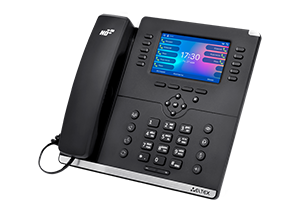
In the second quarter, the VP-100P IP phone will be released. The model is aimed at executives, contact center operators, and anyone who needs maximum functionality in a single device. The phone runs on an Android-based OS, allowing applications to be installed and enabling multitasking. It features a 7-inch touchscreen display, Wi-Fi, Bluetooth, and a camera for video communication, everything required for a modern IP phone. The camera is detachable, so it can be easily removed in environments with strict security requirements.
The VP-100P supports both wired and wireless handsets. In addition, we are developing the VP-EXT100 console to extend the phone’s capabilities for handling a larger number of lines.
- Basic IP phone
The VP-19P will be released in the fourth quarter. It is an updated version of the VP-17P. The main change is a color display instead of a monochrome one. The core specifications remain the same: four SIP lines, a quad-core processor, and HD Voice.
The integrated Gigabit switch allows both the phone and a computer to be connected to a single port, reducing cable clutter on the desk. The phone is powered via PoE, with no additional power adapters required.
The model is designed for users who need a reliable work tool without excessive functionality.
Machine Learning and AI
Artificial intelligence is transforming the way we use voice communications. Call transcription and service quality analysis no longer require manual processing. This year, we are launching two tools: voice analytics and intelligent IVR. Both solutions will be integrated into ECSS-10 and other products.
- Voice analytics
By the end of the year, we will release a speech analytics service. It recognizes speech in real time, converts it into text, and analyzes the content of conversations. It is suitable for evaluating contact center performance, monitoring internal communications, and assessing customer service quality.
The system will be able to detect emotions and conflict situations, highlight keywords, generate a brief summary of the conversation with a topic map, and provide detailed lexical statistics. All tools will be integrated into an interface where users can easily find a specific conversation, assess customer’s mood, and understand how effective the interaction was.
- Smart IVR
In the second quarter, we will release Smart IVR, an AI-based voice routing tool. When a call is received, the caller is greeted not by a button menu but by a voice assistant. The user can simply say who they want to reach or ask a question.
The system will recognize free-form requests, understand the caller’s intent, and either respond directly or route the call to the appropriate specialist. This tool helps reduce waiting time and, as a result, decreases the load on operators.
Security
Involving external experts in data protection and communication system stability provides customers with additional assurance. Joint work is planned with Positive Technologies and Kaspersky Lab, leaders in the domestic information security market. Specialists from these companies will test Eltex VoIP solutions for vulnerabilities, analyze the architecture, and propose ways to address potential issues.
At the same time, the development process is being redesigned. Secure coding, static analysis, and automated checks are being integrated into the lifecycle of new product development and the modernization of existing solutions.
Identified issues in Eltex VoIP products will be resolved in subsequent product updates. The completion of this work is scheduled for the third quarter of 2026.
Conclusion
The Eltex VoIP line continues to evolve, from updates to the core network architecture and the introduction of AI-based services to the release of new phone models and a collaboration platform. Our goal is to provide businesses and telecom operators with a complete ecosystem where all components interact seamlessly, are easy to manage, and are protected against modern threats.
If you have any questions about the functionality of the new solutions or would like to select hardware and software for your project, please contact us at: foreign.sales@eltex-co.ru