Automation with video analytics

Modern video surveillance systems can be compared to a “smart home” control system. The key factor here is not the equipment itself, but the ability to create automation scenarios. This approach helps improve the transparency of on-site processes, reduce response times to incidents, and ease the workload on employees.
We implemented this mechanism using the EVI platform’s intelligent analytics module. Here is how it simplifies administration in organizations, similar to the IoT devices in your home.
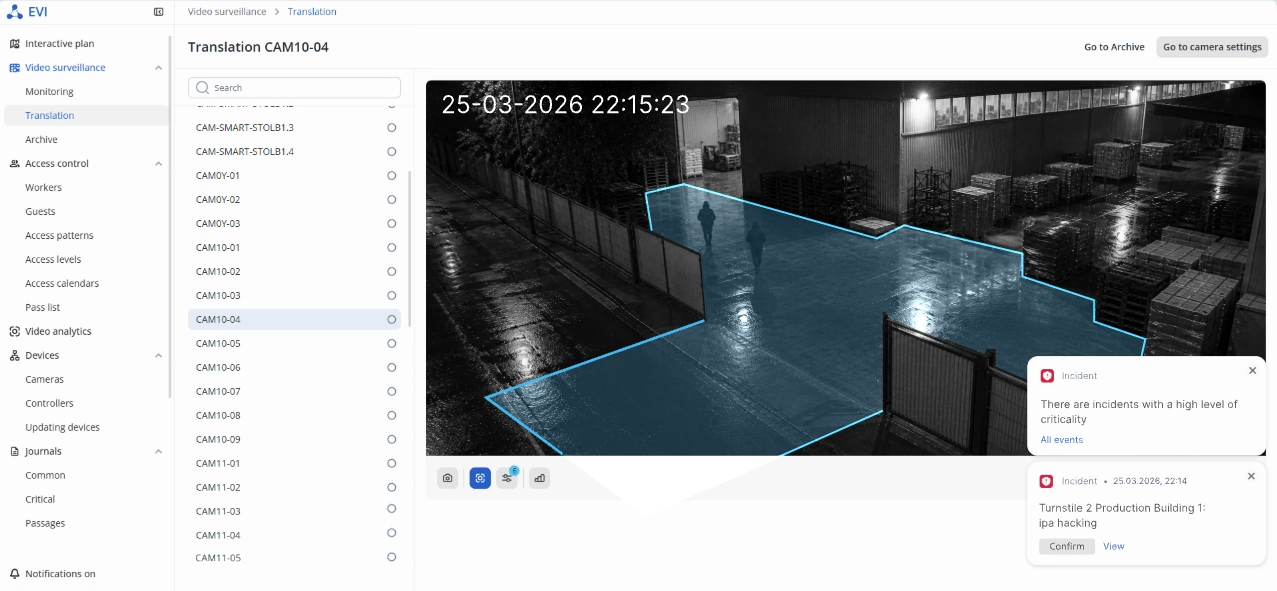
Motion detector
Similar to “smart lights” that switch on when someone passes by a sensor, the EVI Platform supports motion detection. The administrator defines areas for analytics and sets the conditions for triggering alerts.
A possible scenario: a manufacturing facility, at night. A group of intruders has entered the warehouse. The system detects this and sends an alarm signal to the operator, specifying the location. These features enable a rapid response to incidents.
Face recognition
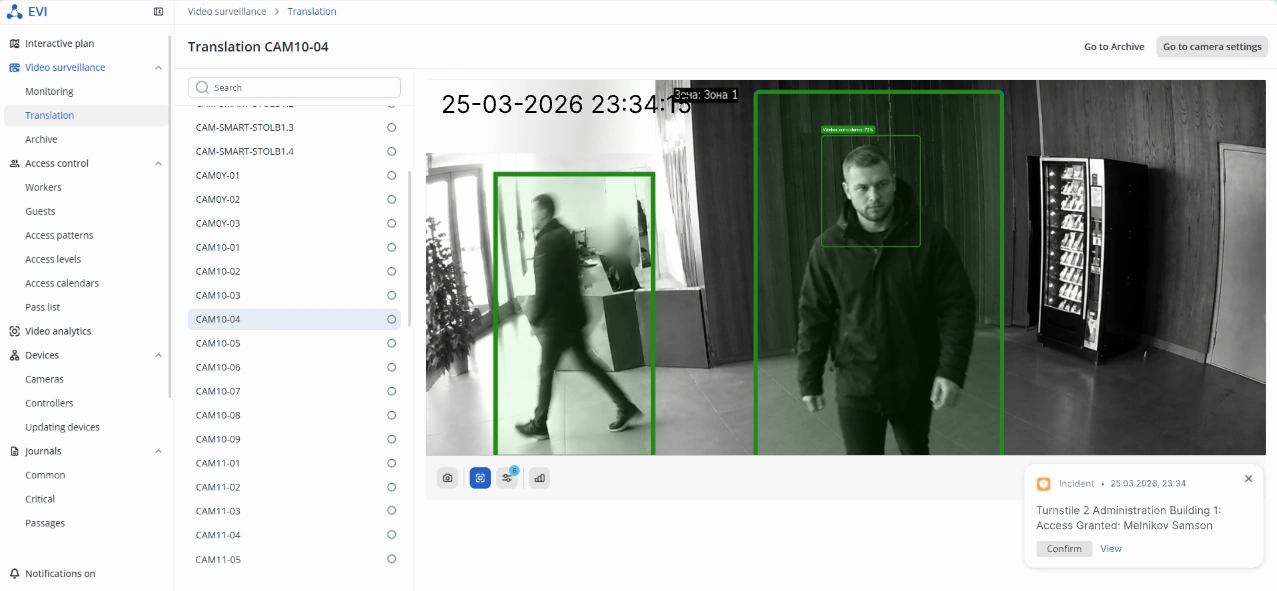
The facial recognition feature eliminates the manual verification of visitors. Administrators create a database, categorize people into groups — employees, contractors, and guests, and set access rights for them based on location and time.
At the access point, EVI identifies the person and applies the specified rules. For example, at a large company, a canteen employee is only permitted access to the dining area and the kitchen. If the employee attempts to enter administrative or production areas, the system will detect the violation and send a notification.
Distinctly implemented scenarios for list-based recognition that do not link to personal data. For example, in retail, this capability allows businesses to identify unwanted visitors and promptly notify employees. In the service industry, it automatically informs employees about the VIP guests' arrival.
When managing visits by guests or contractors, administrators can set the duration of their stay on the facility. If a visitor remains on the facility longer than permitted or arrives outside the authorized time window, EVI also alerts the operator. Additionally, EVI generates a movement history that allows for the analysis of visitor behavior.
License plate number recognition
A similar approach applies to vehicles. The administrator creates lists of vehicles in advance, specifying the following attributes: license plate number, vehicle type and color, vehicle owner, and access group.
When a vehicle approaches a gate or barrier, the algorithms analyze the license plate number, check it against the database, and apply the specified scenario: opening the gate, restricting access, or logging the event.
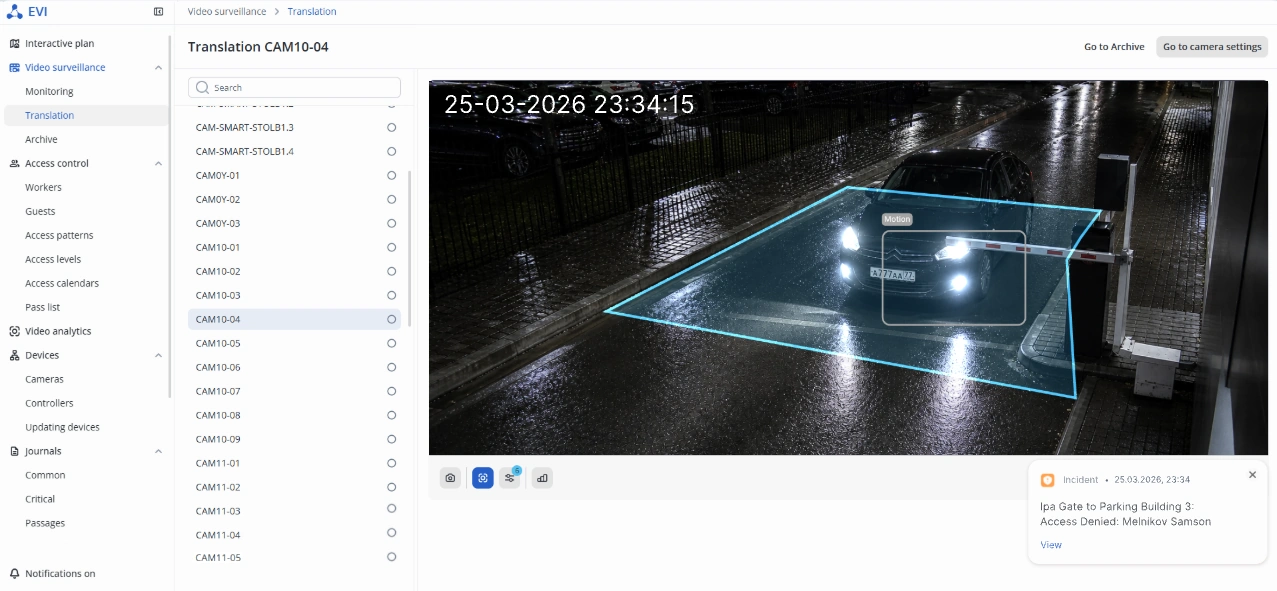
In practical scenarios, such as residential complexes, a general list of vehicle license plate numbers is used without linking them to specific owners. If a match is found in the database, the system triggers an action and opens the gate or barrier via the controller.
It is possible to configure custom scenarios if necessary. For example, you can prohibit all commercial vehicles from entering during nighttime hours or restrict access to vehicles of a certain color.
Lines crossing
Movement monitoring within the facility is implemented using a line crossing function. The administrator defines the permitted boundaries on the camera streams.
Typically, it is used at checkpoints or in areas with regulated traffic. As long as people move in accordance with the established rules, the system does not react. An event is triggered when a line is crossed. This feature allows you to track not only the presence of a person but also the correctness of their movements within the area.
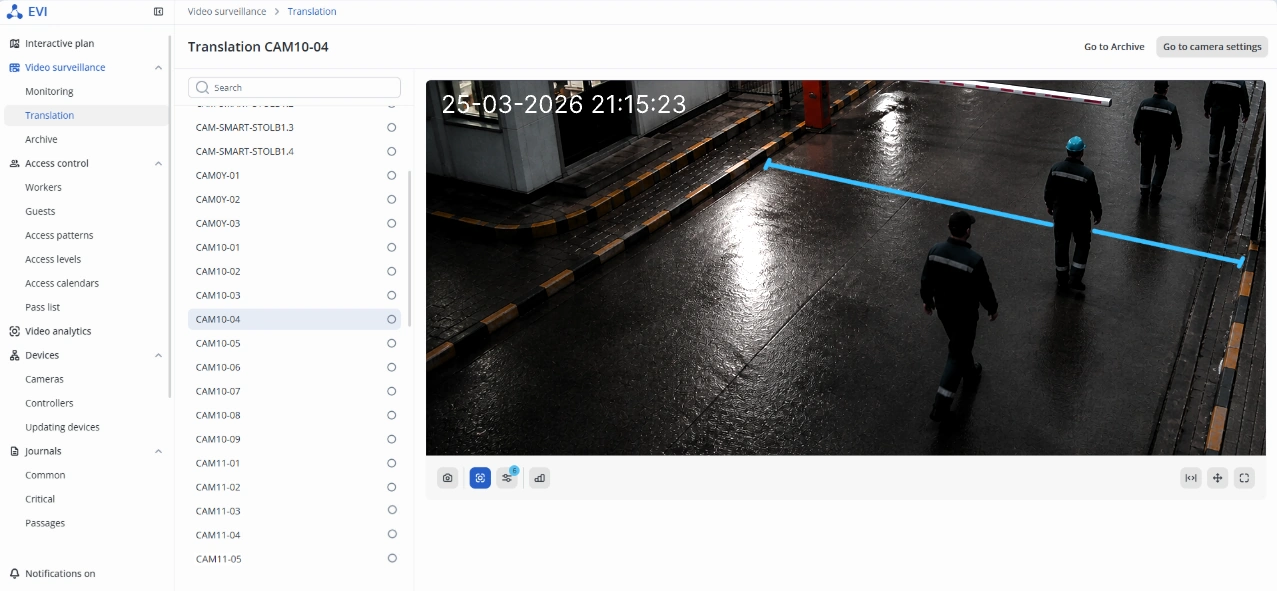
Entering and exiting the zone
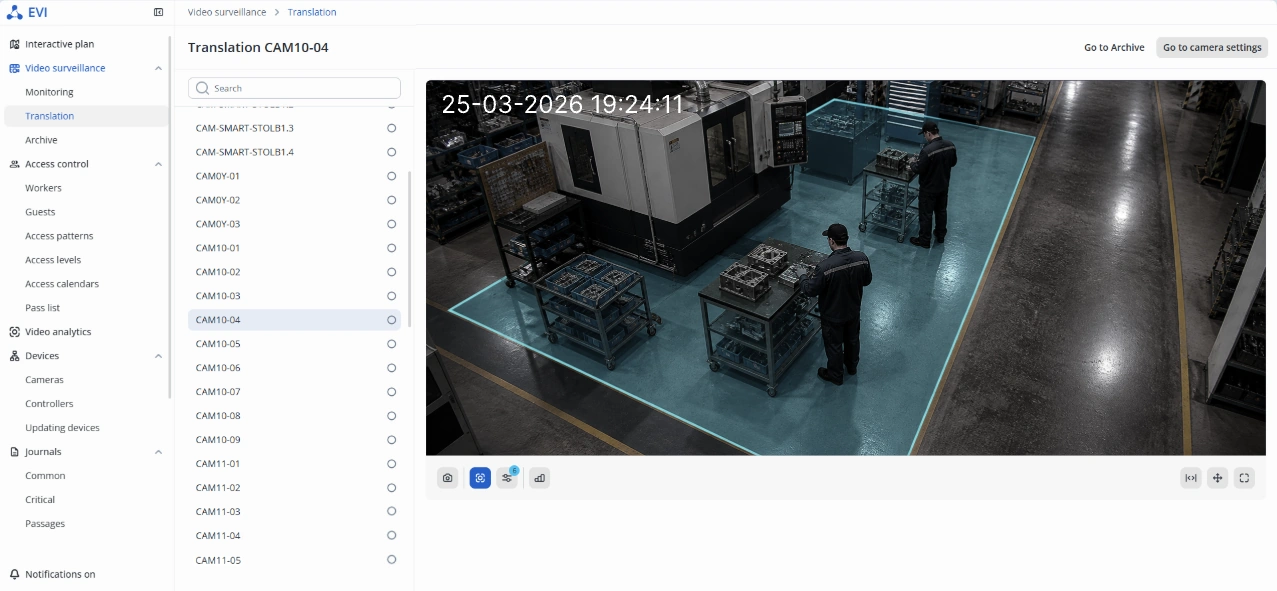
The zone entry/exit function works on a similar principle. The image shows the designated areas and specifies the conditions under which entering or leaving the zone is considered an event.
Such an algorithm may be useful for sites with strict regulations—for example, in manufacturing facilities. EVI detects when a person is present in a designated zone. If the system detects deviations from the expected scenario, for example, if an employee leaves the zone or the number of people exceeds the permitted limit, a notification is sent to the operator. The possible scenarios can be configured independently.
More than just analytics: a unified management system
Video analytics in EVI is an integral part of the software’s overall architecture. The platform integrates video surveillance with event archiving and quick search capabilities, an access control system with flexible permissions and scenarios, configurable alerts with severity levels, and control of access control devices, such as doors, turnstiles, gates, and barriers.
“Sometimes we compare EVI to a “smart home”, but it’s already at the level of a “smart enterprise”, where scenarios operate not just on the scale of a single apartment, but across the entire facility. It is a unified ecosystem where all events and actions are coordinated with each other. Eltex cameras record events, analytics interpret them, and the system triggers predefined scenarios. Users configure these scenarios once, and the platform operates automatically thereafter. The solution automates operators’ tasks, increasing process transparency and minimizing risks associated with human error.”
Olga Nagornova, Product Manager, Media Eltex Department
To test the EVI Platform and the Eltex IP camera fleet in real-world conditions and see how the scenarios work in practice, please contact the Eltex Sales Department: foreign.sales@eltex-co.ru.