A solid foundation for enterprises: how to deploy an invulnerable industrial network


Network modernization as a condition for sustainable growth

Business growth often occurs not through abrupt technological advances, but through systematic modernization. This requires a solid foundation — a manageable network that doesn't require constant intervention.
The issue of updating and maintaining infrastructure is particularly acute for production facilities. Short-term outages can result in significant losses. Therefore, it is essential to select fault-tolerant equipment capable of withstanding extreme conditions.
“Industrial networks are now a new strategic asset. To consciously move towards enterprise improvement — increasing productivity, reducing downtime, improving quality control and safety, and digitalization — it is essential to modernize the infrastructure first. Only by establishing a reliable foundation we can guarantee the predictability of technological processes and future growth”.
Roman Polukhin, Product Manager at Eltex
For these applications, we have developed and continue to actively develop a series of industrial MES switches. The equipment is already being used in various industries, including in the energy sector for substation control and meter reading collection. In the oil and gas sector, it is used for pipeline monitoring and alarm transmission.
In this article, we will explain what the product line consists of, what capabilities the equipment offers, and how we test its durability.
MES product line
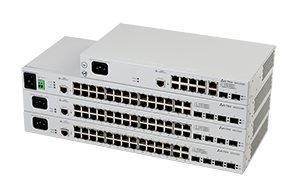
The MES series of industrial switches is not a set of individual devices, but an entire family designed in accordance with a complex engineering logic. As elements of a single system, they complement each other, ensuring network connectivity from the edge level to the management one.
The product line consists of rack-mount switches and DIN-rail models. The advantage of this entire range of equipment is a variety of interface types: copper, fiber, and combo ports. DIN-rail devices support PoE and PoE+ technologies, allowing IP cameras and access points to be powered directly from the switch. Throughput ranges from 20 to 128 Gbps.
- Management level switches MES2300DI-28, MES3400I-24, MES3500I‑24F have support for stacking, which enables redundancy and centralized management of device groups. Such devices are designed to aggregate traffic transmitted from edge level switches.
- Edge level switches MES3500I-08P, MES3710P, MES3500I-8P8F, and MES3500I-10P are designed for use adjacent to other industrial equipment. They transmit data from executive devices, controllers, sensors, access points, video cameras, machining facilities, and automated systems. The switches are capable of operating in extreme conditions, including high temperatures, humidity, and vibration.

The MES series was conceived as a reliable and flexible foundation for designing industrial network architectures. We discussed how to deploy a data transmission network at industrial facilities using Eltex switches in the "Solutions" section.
We continue to develop our product line. The range of industrial MES is expected to expand in 2026. MES3510S-08P will be released in the first quarter, and MES3510DS-24F in the second. They will support the protocols and technologies necessary for networking industrial facilities — PRP and PTP, and later, SyncE and HSR.
Functional capabilities
As in any well-coordinated system, each device in the industrial MES family has its own specific tasks. But they all share the same common principle: reliable and predictable network operation. To achieve this, all the equipment supports an impressive range of functions.
The MES35xx(xx) and MES2300DI-28 models implement important L3 features. One of the key capabilities is VRF technology, which enables the isolation of various traffic types.
The PIM SM protocol plays a key role, providing efficient multicast traffic distribution. Thus, an alarm signal from a sensor can reach all nodes subscribed to the corresponding message in a fraction of a second. This helps instantly enable emergency mode or shut down a process device.
The MES35xx(xx) and MES2300DI-28 models can also function as routers. They support dynamic routing protocols such as RIP, OSPF, and BGP.
Along with L3 features, the MES series also offers key L2 features. For example, the ERPS protocol, which will be discussed in the next section, IGMP Snooping, MVR, and Loopback Detection.
The architecture is complemented by a comprehensive set of traffic prioritization tools (QoS). This means that critical traffic (control and signaling protocols, telemetry) will be delivered first regardless of the load.
Security and fault tolerance
For industrial networks, stability is a mandatory requirement. Reliability in MES is implemented at both the hardware and protocol levels. Support for the Ethernet Ring Protection Switching (ERPS) protocol is particularly important in production and mining environments. It ensures connection redundancy in a ring topology. In the event of a line failure, ERPS automatically changes the data transmission path, restoring communication in less than one second.

Fault tolerance can also be provided by a number of other protocols, such as STP, RSTP, MSTP, RPVST+.
The industrial switch series by Eltex supports advanced access control mechanisms. L2–L4 ACLs allow traffic filtering based on a variety of parameters, including MAC and IP addresses, ports, and protocol types. IP Source Guard and Dynamic ARP Inspection prevent IP and MAC address spoofing, protecting the network from typical access layer attacks.
Trial by fire
Testing is one of the most important steps in the development of industrial equipment. Each model must demonstrate its reliability under maximum loads, so Eltex conducts a comprehensive series of tests.
- Power consumption measurement. Our specialists stress each switch: they create a broadcast storm on all ports, apply USB load and peak PoE load. This allows us to determine maximum consumption and test the power supply for stability.
- Temperature testing. All devices are tested in a temperature test chamber under extreme operating conditions (at both the extreme negative and positive temperatures) under full load (a storm on all ports and maximum PoE load). During this testing phase, we check the cold start of the device at minimum and maximum temperatures. We also monitor the normal operation of the device at maximum temperature, ensuring the absence of port errors and PoE operation. Thermocouples and temperature loggers are used to identify hot spots. If necessary, the device design is modified to ensure more efficient heat dissipation. This prevents exceeding the maximum permissible component temperature.
- Interface testing. Using a wideband oscillograph and specialized measuring equipment, we check the signal integrity on high-speed ports, compliance with the IEEE 802.3 standard, and port connection parameters to ensure signal transmission with minimal distortion and loss.
- Electrostatic discharge testing. Under laboratory conditions, the device is subjected to direct and indirect electrical discharge. A discharge of several kilovolts simulates a static shock that can easily occur during equipment operation and in industrial facilities. The task of the switch under test is to maintain functionality and ensure a stable, uninterrupted connection.

“Industrial equipment is tested over an extended ambient temperature range from -45 °C to +75 °C, with exact readings depending on the model. We pay particular attention to the dynamic behavior of devices, observing how parameters change during transient processes. For example, when PoE is enabled, when traffic suddenly increases, or when links are switched. It is important not only to pass standard tests but also to understand the safety margin. We conduct some tests by deliberately going beyond specifications: increasing the temperature above the nominal value and introducing additional sources of interference. If the device operates stably after this, you can be confident that it will perform well in a real network”.
Maksim Prokopiev, Head of MES Network Switches Department, Broadband Service Center
The industrial switches featured in the Eltex catalog operate under temperatures from –40 °C to +70 °C, depending on the model. The equipment is housed in metal enclosures with IP30 protection and features a passive cooling system.
Various power supply options are supported: AC/DC for management level switches or dual DC units for other models. The switches are compatible with standard AC and DC power sources (PM160-220/12, PM165-220/12, and PM100 48/12 power supplies). For DIN-rail models, the DRS-270-56 power units are available. For energy facilities, PM65-220/12 is suitable. All models support power redundancy, ensuring uninterrupted operation even if one terminal fails.
The PoE budget for the corresponding models reaches 240 W. The exact specifications depend on the chosen switch.
Automated network in industry
A reliable switch is half the story; the other half is constant control and transparency of the entire network. Each industrial MES model is part of the Eltex complex intelligent ecosystem.
ECCM (Eltex Cloud Configuration Manager) is a software solution that makes infrastructure management clear and predictable. The administrator can see the network topology and centrally monitor and manage the status of each device. All software capabilities are described in the solution.

Another advantage of using MES switches is compatibility with Network Access and Information Control Engine (NAICE). It provides authentication, authorization, and accounting of all wireless and wired connections to network resources, as well as connections to network equipment. The NAICE overview is available on a special page in the “Solutions” section.

Together, these tools create a comprehensive platform for designing and maintaining industrial networks.
The industrial MES switches cover a wide range of scenarios. Our specialists will help you select the right configuration for your specific needs. For detailed information, please contact Eltex Sales Department at foreign.sales@eltex-co.ru.